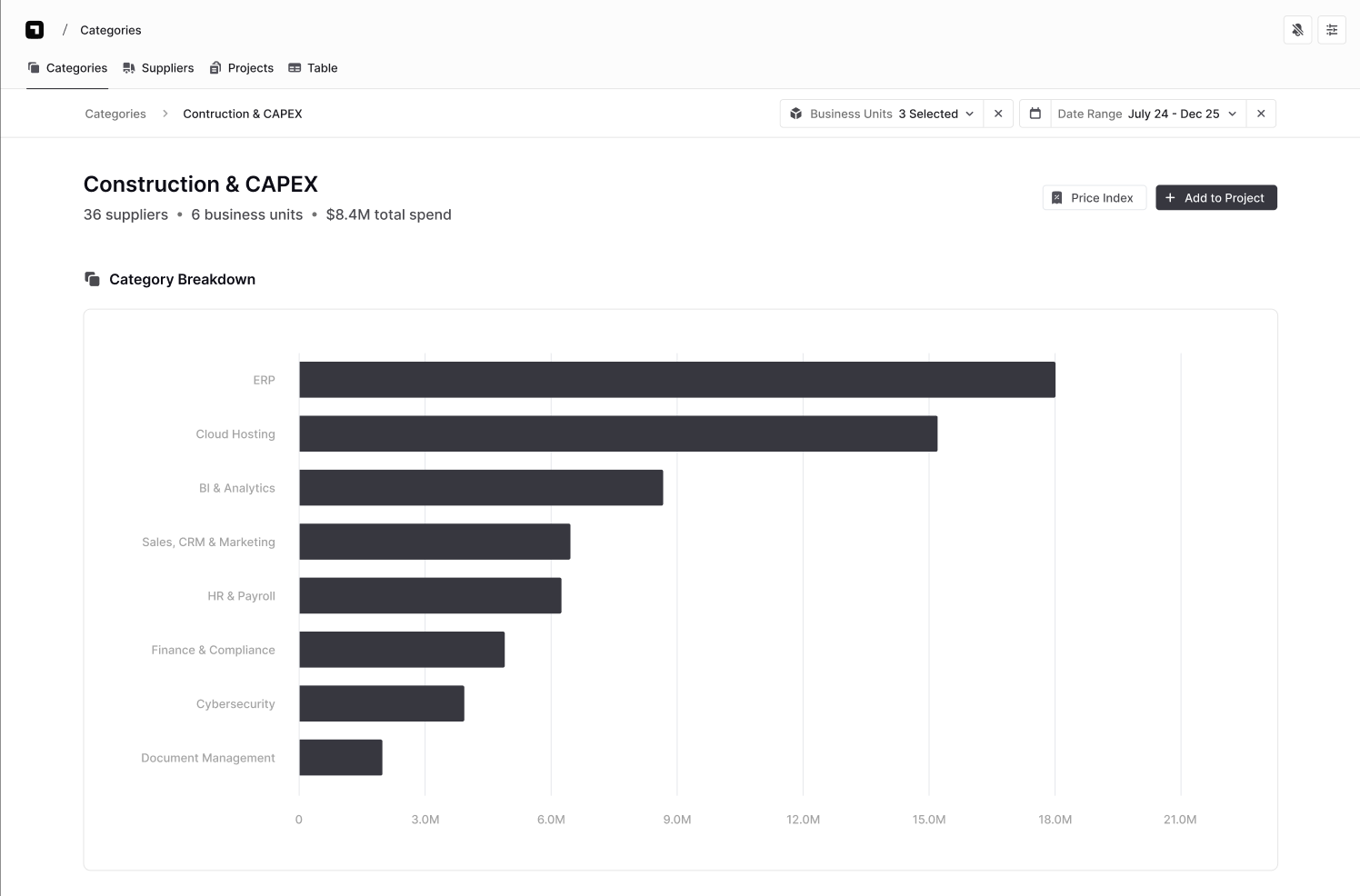
When your CFO asks which vendors pose the highest risk next quarter, that typically requires days of manual data extraction, spreadsheet analysis, and cross-referencing contracts, resulting in no confident answer. The organization has millions of rows of data, but lacks actionable intelligence.
This represents the fundamental procurement intelligence gap. Traditional procurement systems excel at cataloging transactions, storing contracts, and tracking purchase orders. What they fail to do is transform that data into actionable intelligence. They document what happened, not what's likely to happen or how teams should respond.
Artificial intelligence (AI) and machine learning are fundamentally changing this dynamic. Instead of relying on reactive record-keeping, procurement teams can now make informed, predictive decisions. Instead of spending weeks analyzing data, they can surface insights in hours. This article explores five AI applications that deliver measurable results in procurement today.
How machine learning classifies spend in hours, not weeks
Most procurement teams invest weeks categorizing transactions yet still face 15-20% miscategorization rates. The root cause is straightforward: traditional classification relies on rigid rule-based systems that cannot accommodate the complex reality of procurement data.
When a $50,000 "IT Services" category actually encompasses cloud storage subscriptions, management consulting fees, and software licenses, category intelligence becomes unreliable. Teams cannot identify savings opportunities, negotiate effectively, or accurately understand organizational spending patterns.
Machine learning-powered classification operates differently. Rather than following predetermined rules, ML models recognize patterns across transaction descriptions, vendor names, and historical categorization. These models learn that "Azure storage" and "AWS S3" belong in cloud infrastructure rather than generic IT services—even when ERP systems have coded them identically.
The business impact is substantial: spend classification that previously required weeks now completes in hours, and procurement teams have data reliable enough for strategic decision-making.
But human review remains valuable for edge cases. When ML models encounter genuinely ambiguous transactions, they flag them for review rather than making uncertain classifications. This hybrid approach of combining machine efficiency with human judgment delivers both accuracy and speed.
How AI finds qualified suppliers you didn't know existed
Supplier discovery has traditionally depended on institutional knowledge, manual research, and, to some extent, fortunate timing. Teams search industry directories, consult colleagues, or work with established suppliers. But the limitation is that qualified vendors using different terminology or serving adjacent industries remain invisible.
Intelligent supplier matching addresses this gap. ML models evaluate suppliers across multiple dimensions—capability fit, capacity availability, quality track record, pricing competitiveness, and risk profile—then rank recommendations based on specific requirements.
The differentiator is AI surfaces suppliers with relevant capabilities who do not appear in standard searches. A manufacturer seeking "precision metal fabrication" might overlook a supplier listed under "aerospace components manufacturing" who possesses exactly the required capabilities and available capacity.
This shifts how sourcing teams allocate their time. Rather than spending days identifying potential suppliers, they can focus on evaluating qualified options. RFP cycles compress from weeks to days because teams begin with stronger candidate pools.
How AI predicts supplier risk before it becomes a problem
Annual supplier risk assessments contain an inherent flaw: suppliers do not typically experience difficulties on the assessment schedule. By the time quarterly scorecards flag issues, teams are already responding reactively.
Many "risk monitoring" tools simply report problems faster; they are not genuinely predictive. Effective predictive risk models function differently. They continuously monitor signals, including financial health indicators, delivery performance trends, geopolitical factors, and supplier concentration patterns.
A supplier might experience moderate financial stress, operate in a region facing new trade restrictions, while the buyer's inventory of their components runs low. Individually, none of these factors triggers intervention. Combined, they represent a material risk to supply continuity.
Instead of quarterly risk reviews, teams receive daily exception-based alerts for situations requiring action. The operational challenge becomes avoiding alert fatigue, surfacing the 10 risks that need immediate attention, not the 1,000 data points that have changed.

Why procurement can't answer basic questions about their contracts
When contract terms exist as unstructured text in PDFs, procurement teams cannot answer portfolio-level questions. How many contracts contain auto-renewal clauses? Which suppliers can implement price increases unilaterally? What is the organization's total exposure to force majeure provisions?
Without contract intelligence capabilities, teams must search document by document—or worse, rely on institutional memory about what terms exist within their contract portfolio.
Natural language processing extracts key terms, obligations, renewal dates, and pricing structures from unstructured documents. More importantly, it surfaces unfavorable terms embedded in standard legal language. An innocuous clause stating "pricing shall be adjusted annually based on supplier's published rate card" is actually an uncapped price escalation mechanism.
The portfolio view delivers the strategic value. Instead of asking "What terms exist in this contract?" teams can ask "Across 500 contracts, where does the organization face exposure to unilateral price increases?" Contract intelligence enables proactive portfolio management rather than reactive crisis response.
Why traditional demand forecasting fails (and how ML fixes it)
Projecting "last year plus 10%" is not forecasting. It's an extrapolation based on limited data. Historical averages cannot account for changes in business trajectory, shifts in seasonality, or market disruptions. Yet this approach remains common in procurement demand planning.
ML-powered forecasting incorporates sales pipeline data, production schedules, market trends, and seasonality patterns. The models continuously adjust predictions as new data becomes available.
The substantive value lies in identifying leading indicators within purchasing behavior. An increase in expedited orders signals emerging capacity constraints before they become critical. Changes in component mix predict demand shifts before they appear obvious in aggregate figures.
The implications extend beyond procurement operations. Improved demand forecasts enable working capital optimization. When procurement can predict requirements accurately, finance can simultaneously optimize inventory levels and cash flow.
What agentic AI in procurement can (and can't) do today
Agentic AI represents a fundamental shift from "AI recommends, human acts" to "AI acts, human approves." This approach is delivering results today in specific use cases, including routine negotiations with non-strategic suppliers, autonomous invoice processing for low-risk categories, and automated improvements to payment terms.
A procurement organization might deploy agentic AI to manage tail spend—thousands of low-value suppliers where manual negotiation is economically unviable. The AI negotiates payment terms, processes invoices, and flags exceptions for human review.
However, agentic AI is not yet effective for strategic sourcing, complex negotiations, or situations that require relationship management. The technology continues to mature, and the stakes in these areas remain too high for autonomous operation.
The trust threshold merits careful consideration. Human oversight remains essential, but approval workflows require thoughtful design. If every AI action requires manual approval, organizations simply create new bottlenecks rather than successfully automating.
What works now vs. what's still emerging
Spend classification and contract intelligence generate value within weeks rather than months. These capabilities require minimal integration and function with existing data.
Applications requiring longer-term investment, such as predictive risk monitoring and demand forecasting, typically require 6-12 months to train models and validate accuracy. They require clean, integrated data from multiple systems.
The data presents an uncomfortable reality: MIT research indicates 95% of enterprise AI pilots deliver no measurable ROI. When AI implementations succeed, it is typically because the tools integrate effectively with existing ERP and P2P systems. Most AI benefits dissipate when teams manually export data to AI tools, then import results back to operational systems.
The more significant barrier is organizational change management. Procurement teams must develop sufficient confidence in AI-generated insights to act on them. That requires transparency into how models function, not simply accepting "the AI recommends" as justification.
From data collectors to intelligence operators
AI and machine learning are transforming procurement work from data entry and report generation toward strategic decision-making. The role evolves from answering "What did we spend last quarter?" to addressing "Where should we focus resources next quarter to maximize impact?"
What remains unchanged: the need for human judgment in negotiation, relationship management, and understanding context that AI cannot interpret. The goal is not to replace procurement professionals; it's to eliminate manual work that prevents them from contributing strategic value. Better data enable better models, which support better decisions, which in turn generate better data.