While procurement teams debate supplier relationships and negotiate contracts, companies with mature data management systems are making faster decisions, capturing hidden savings, and responding to market disruptions before competitors recognise the pattern.
This isn't about dashboards or analytics platforms. It's about whether your organisation can answer critical procurement questions in hours instead of weeks.
The real cost of fragmented spend data
Most procurement teams operate with a fundamental handicap: their data lives in multiple systems, formats, and classification schemes. This fragmentation creates three specific problems that slow decision-making and obscure opportunities.
Decision paralysis. When procurement leaders need to answer "Should we consolidate suppliers in this category?" or "What's our exposure to this at-risk region?", the response requires weeks of data gathering. According to the European Institute of Purchasing Management, procurement teams spend 40% of their time on data preparation rather than strategic analysis. Competitors with clean, centralised data are already executing while your team is still building spreadsheets.
Invisible opportunities. Without unified spend visibility, procurement teams miss consolidation opportunities, duplicate contracts, and maverick spending patterns. Deloitte's 2024 Global Chief Procurement Officer Survey found that organisations with fragmented data capture only 60% of available savings opportunities. The other 40% remains hidden across decentralised purchasing records.
Compliance vulnerability. Regulatory requirements in Europe—from VAT compliance to CSRD sustainability reporting—demand accurate spend categorisation. Manual data reconciliation increases error rates and creates audit risk that finance teams won't tolerate.
What procurement data management actually means
Strip away the vendor jargon: procurement data management is the collection, standardisation, and organisation of purchasing information into a format that supports rapid decision-making.
This involves three core components:
Centralised spend repository. All purchasing data—purchase orders, invoices, contracts, supplier records—flows into a single system of record. No more hunting through departmental spreadsheets or regional ERPs.
Standardised classification. Spend gets categorised using consistent taxonomies (UNSPSC, custom hierarchies) so you can compare costs across business units, identify consolidation targets, and track category-level trends.
Continuous validation. Automated quality checks flag anomalies, duplicate entries, and classification errors before they distort analysis.
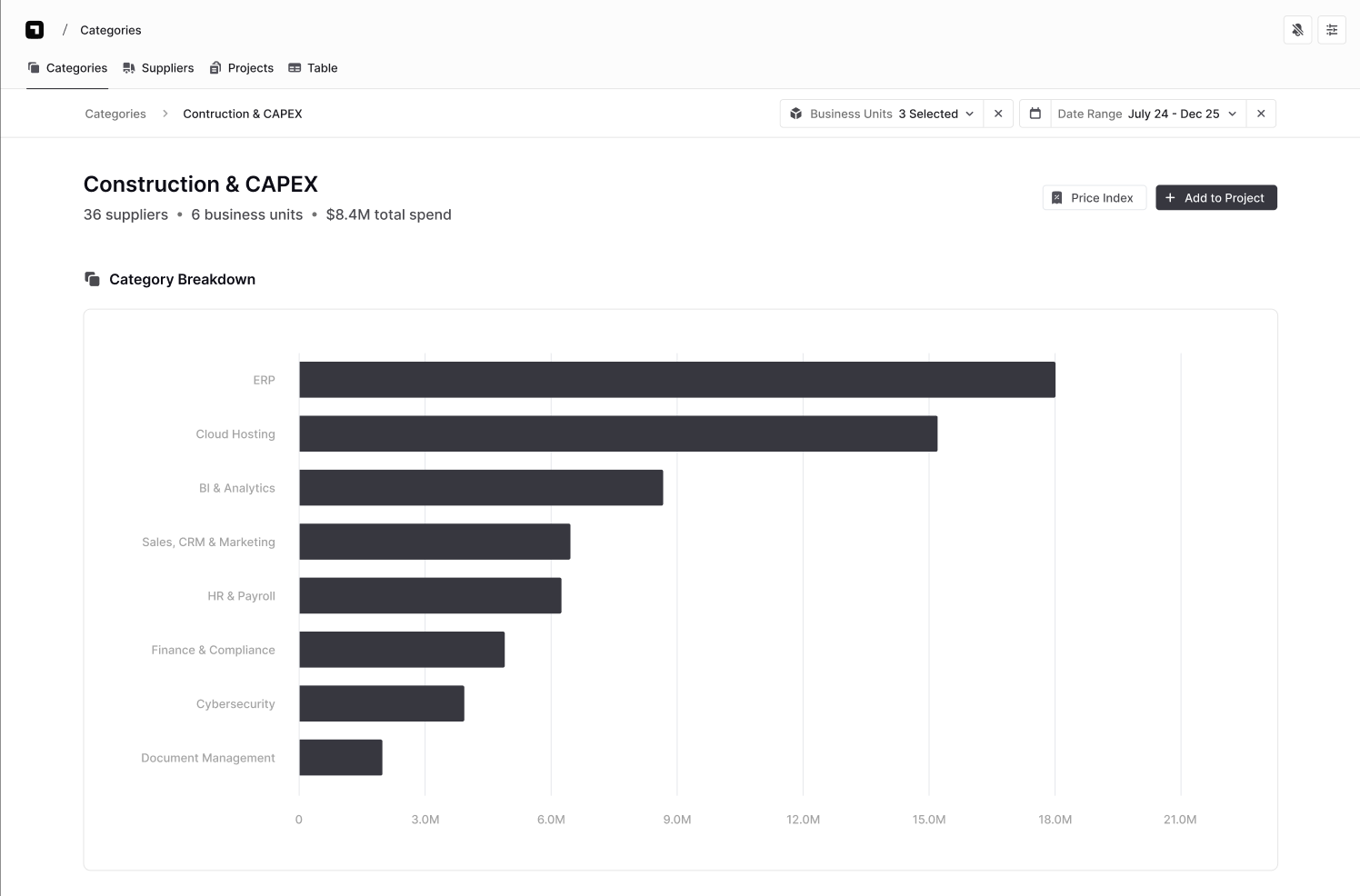
The technical term for this structured data environment is a "spend cube"—a multi-dimensional view of procurement data that enables analysis across suppliers, categories, time periods, and business units simultaneously.
4 competitive advantages of clean spend data
Faster strategic decision-making
When procurement operates with clean, centralised data, the time from question to decision collapses.
Consider supply chain disruption response: if a key supplier faces financial instability, how quickly can you identify alternative suppliers, assess switching costs, and quantify volume commitments?
With fragmented data, it takes 2–3 weeks of manual analysis across multiple systems. With centralised spend management, it takes 2–3 hours of filtered queries and scenario modelling.
This speed advantage compounds across common procurement decisions: category strategy development, make-vs-buy analysis, supplier consolidation assessments, and contract compliance monitoring. The Hackett Group's research shows that top-performing procurement organisations make category decisions 65% faster than peers, primarily due to data readiness.
More accurate forecasting and budgeting
Finance teams scrutinise procurement budgets because they're traditionally unreliable. Without historical spend patterns by category, supplier, and seasonality, procurement teams default to last-year-plus-inflation estimates.
Mature spend data management enables:
- Trend analysis: Identify category-level spending patterns, seasonal fluctuations, and volume correlations that improve forecast accuracy
- Price volatility modelling: Track supplier price movements over time to anticipate budget impacts
- Scenario planning: Model the budget impact of supplier consolidation, contract renegotiation, or strategic sourcing initiatives before committing
The European Commission's public procurement indicators demonstrate that organisations with systematic spend tracking reduce budget variance by 20–30% compared to those relying on decentralised records.
Stronger supplier negotiations
Negotiation leverage depends on information asymmetry. Suppliers understand their customers' spending patterns; most procurement teams don't understand their own.
Clean spend data reveals exactly what you need to shift the balance:
- Total addressable spend: The consolidated view of all spending with a supplier across business units and categories
- Price benchmarking opportunities: Compare unit prices across similar purchases to identify normalisation targets
- Volume commitment leverage: Quantify actual spending volume to negotiate tier-based discounts
- Switching cost analysis: Assess the financial impact of shifting volume to alternative suppliers
CIPS (Chartered Institute of Procurement & Supply) research indicates that procurement teams with comprehensive spend visibility achieve 8–12% better pricing outcomes in category negotiations compared to teams operating with fragmented data.
Defensible compliance and risk management
European procurement teams face increasing regulatory scrutiny: VAT compliance, sustainability reporting under CSRD, modern slavery disclosure, and sanctions monitoring. Manual compliance processes introduce error rates that audit teams flag immediately.
Systematic spend data management creates an auditable trail:
- Supplier due diligence: Track supplier certifications, audit results, and compliance documentation in a central system
- Spending pattern monitoring: Automatically flag unusual transactions, policy violations, or potential fraud
- Regulatory reporting: Generate compliance reports directly from standardised spend data rather than reconstructing information across systems
Building the infrastructure: What actually matters
Most procurement data management initiatives fail because organisations over-engineer the solution. You don't need a perfect system; you need a functional one that improves decision speed.
Priority hierarchy:
- Data integration: Connect primary spend sources (ERP, P2P systems, invoice processing) to a central repository
- Classification standardisation: Implement consistent category taxonomies and automate classification where possible
- Quality validation: Build automated checks for common errors (duplicate invoices, miscategorised spend, incomplete supplier records)
- User accessibility: Ensure procurement teams can query data without IT support
Start with the 80/20 rule: capture the 80% of spending that flows through formal systems before tackling maverick spending, small purchases, and edge cases.
The competitive decision
Organisations that invest in data infrastructure make faster decisions, negotiate better terms, and identify opportunities their competitors miss. The question isn't whether procurement data management creates value—it's how much market advantage you're willing to concede while you wait.