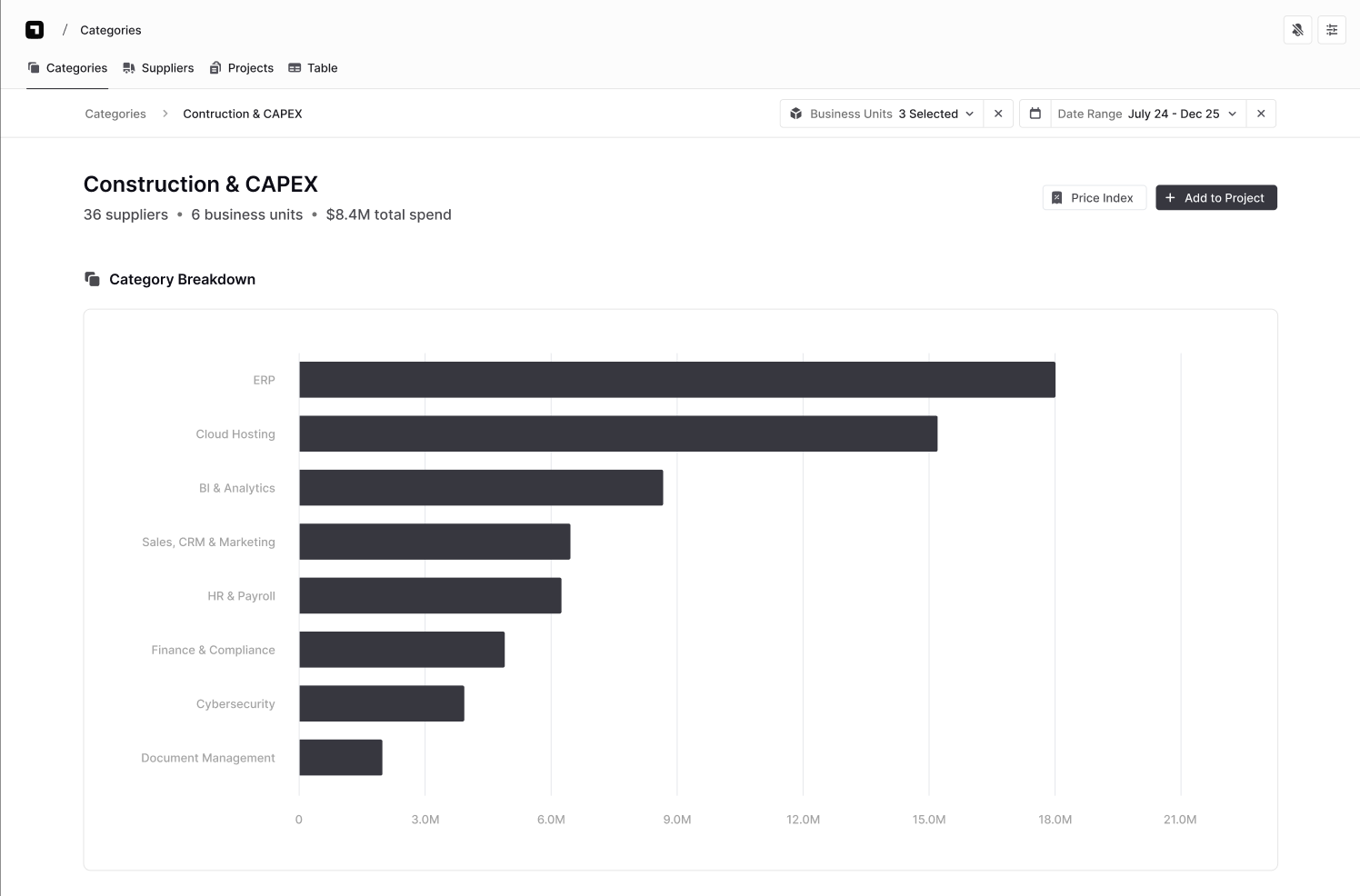
Most procurement teams have plenty of spend data. According to Deloitte's CPO Survey, 89% collect transaction information across their systems. But only 23% actually use it to influence sourcing strategy.
The problem is when raw transactions are translated into defensible recommendations, many shortcuts are taken. Each shortcut in the process compounds into unreliable insights later. Miss a data source during collection, and you'll undercount category spend. Skip thorough cleansing, and your supplier consolidation numbers become meaningless.
This guide walks through each stage of the spend analysis process with specific failure modes and diagnostic questions to help you identify where your approach might be breaking down.
The gap between data collection and strategic procurement value
Most spend analysis efforts stop at descriptive reporting: dashboards showing what happened last quarter. Strategic value requires moving to prescriptive insights (what should happen) and eventually predictive modeling (what will happen if market conditions change).
Think of it as three capability levels: spend visibility → insight → action. Each level builds on the previous one, which is why process discipline matters. APQC benchmarks show that missed consolidation opportunities average 8-12% of addressable spend, often because the underlying analysis had gaps that made the recommendations untrustworthy.
Stage 1: Data collection and consolidation
The challenge: Your spend data lives in fragmented systems—ERP, P2P platforms, procurement cards, AP systems, and subsidiary databases that may not talk to each other.
Common failure mode: Companies collect only PO-based spend while missing 30-40% of total expenditure that flows through other channels.
What to collect:
- Transactional data: PO lines, invoices, payment records, non-PO spend (procurement cards, employee expenses)
- Master data: Supplier records, GL accounts, cost centers, contract repository
- External data: Supplier financial health, market indices, regulatory databases
Diagnostic questions to ask:
- Can you see spend from all legal entities in a single view?
- Do you capture non-PO spend? (Most companies underestimate this by 25-35%)
- How much spend sits outside your core systems?
Considerations:
- Different tax regimes, such as cross-border VAT and inter-state tax considerations
- Regulatory compliance, like GDPR
- Multi-currency normalization
Stage 2: Cleansing and normalization
The challenge: The same supplier appears 47 different ways in your system with slight name variations, different addresses, and inconsistent formatting.
Common failure mode: Over-aggressive automation creates false matches (merging distinct entities), or manual cleansing simply can't scale beyond a few hundred suppliers.
Critical cleansing tasks:
- Supplier deduplication using address matching, registration numbers, and bank account data
- Currency standardization (spot rates vs. average rates—this choice affects trend analysis)
- Date format alignment across systems
- Unit of measure standardization
- Null value treatment (critical for downstream category assignment)
Normalization decisions that affect downstream analysis:
One normalization decision significantly impacts downstream analysis: Should you normalize historical spend to current EUR values? The answer is yes for trend analysis, no for budget compliance tracking.
How do you handle one-time FX gains/losses in spend totals? Do you include or exclude VAT/duties in category spend? This affects benchmark comparisons.
Diagnostic questions:
- What percentage of your spend requires manual review? If more than 15% of your spend requires manual review, you have a data quality problem.
- Can you trace a cleaned record back to its source system?
- How do you validate that deduplication didn't over-consolidate distinct entities?
The quality threshold to aim for is 95% clean data is the minimum for reliable strategic analysis.
Stage 3: Categorization and enrichment
The challenge: Generic category schemes like UNSPSC or eCl@ss don't align with how your business actually buys or how markets are structured.
Common failure mode: Over-categorizing into 500+ subcategories that become unmaintainable, or under-categorizing into 20 broad buckets that hide consolidation opportunities.
Categorization approaches:
- Standard taxonomies: UNSPSC (good for cross-industry benchmarking), eCl@ss (European standard, better for manufacturing)
- Custom taxonomies: Aligned to your sourcing strategy and category management structure
- Hybrid approach: Standard at high level, custom at tactical level (recommended)
Enrichment layers that enable strategic analysis:
- Spend addressability flags (contractable vs. non-contractable)
- Supplier risk indicators (financial health, geographic concentration, single-source dependencies)
- Category complexity scores (custom vs. standard, technical vs. non-technical)
- Strategic importance ratings (mission-critical vs. leverage vs. tactical)
- Supplier diversity classifications (SME status, regional distribution)
Diagnostic question: Can you answer "How much do we spend on mission-critical custom components with single-source suppliers?" in under five minutes?
For European supplier financial data, Amadeus from Bureau van Dijk provides comprehensive coverage. Eurostat offers category price indices for inflation benchmarking.
Stage 4: Analysis and insight generation
The challenge: Moving from "here's what we spent" to "here's what we should do about it."
Common failure mode: Producing 47-slide decks that describe the spend in detail but offer no prioritized recommendations.
Apply the three analysis lenses:
1. Efficiency opportunities
- Supplier consolidation potential (multiple suppliers per category, each under €50K annual spend)
- Maverick spend rates (off-contract purchasing by category)
- Price variance (same item, different prices across business units)
- Tail spend optimization (suppliers under €10K annual spend)
2. Risk exposure
- Single-source dependencies for critical categories
- Supplier financial distress indicators (declining Altman Z-scores, extended payment terms)
- Geographic concentration (more than 40% of category spend in one region)
- Regulatory compliance gaps (REACH, RoHS, conflict minerals for EU operations)
3. Strategic misalignment
- Spend with non-strategic suppliers vs. preferred partners
- Category strategy execution rates (contracted spend vs. total category spend)
- Sourcing event coverage (spend under competitive tender vs. total addressable)
Diagnostic framework:
- Start with materiality: Analyze categories representing 80% of total spend first
- Apply effort-impact filtering: High-savings potential + Low-implementation complexity = Priority 1
- Validate with stakeholder input: Technical feasibility, business continuity concerns
- Quality test: Can a CFO defend your recommendations in a board meeting without additional analysis?
Stage 5: Action planning
The challenge: Insights don't drive change unless they're translated into specific initiatives with owners and timelines.
Common failure mode: Generic recommendations like "consolidate suppliers" or "negotiate better prices" with no implementation roadmap.
Insight translated to execution:
- Quantify the opportunity with confidence ranges (not false precision)
- Assign specific initiative owners (category managers, not "procurement team")
- Define success metrics (contracted savings, realized savings, payment term improvements)
- Set realistic timelines based on contract renewal dates and resource availability
- Identify prerequisites (supplier qualification, technical specs, stakeholder alignment)
Prioritization framework:
- Tier 1: Quick wins (90-day implementation, <€10K effort, >€100K annual impact)
- Tier 2: Strategic initiatives (6-12 months, significant savings or risk reduction)
- Tier 3: Structural changes (12+ months, requires process redesign or system investment)
European operations require additional considerations: works council consultation for supplier changes, TUPE regulations if moving services between suppliers, and cross-border contract law implications.
Common pitfalls that derail the spend analytics process
- Starting without stakeholder alignment: Category spend analysis without finance validation = wasted effort
- Analysis paralysis: Waiting for perfect data means never starting (80% complete data with clear limitations is better than 100% data in 18 months)
- One-time exercise mentality: Spend analysis must be continuous (quarterly minimum, monthly for volatile categories)
- Ignoring data governance: Without ownership of master data maintenance, quality degrades immediately after cleansing
- Presenting spend without recommendations: Descriptive dashboards don't drive strategic decisions
Building a continuous spend analysis capability
Each stage of spend analysis compounds: poor data cleansing makes categorization unreliable, which makes insights questionable, which makes recommendations indefensible to finance stakeholders.
Three practices separate one-time exercises from continuous capability:
Automate data ingestion and cleansing. Invest in tools rather than manual labor. Your team should spend time on analysis and recommendations, not data preparation.
Establish data governance. Without clear ownership of supplier master data and category definitions, quality degrades immediately after your cleansing project ends.
Create feedback loops. Did recommended consolidations actually happen? Why or why not? This intelligence makes your next analysis cycle more realistic and credible.